Home / File 02
File 02 · London · 1906–1909
London
Six addresses hold the whole of Dhingra's London: a college, a hostel, an exhibition hall, a public meeting room, a courtroom and a prison. They sit within about six miles of one another.
Six addresses
Select a marker to read what is documented about each location.
Six addresses
Choose a marker on the diagram, or a line from the list, to read the documented record for that place.
The Indian student colony
By 1906 there were several hundred Indian students in Britain, concentrated in London, Cambridge, Oxford and Edinburgh. They read law at the Inns of Court, medicine at the teaching hospitals, and engineering and science at institutions such as University College. They were the most privileged fraction of colonial society and, for the British administration, an increasingly difficult one to manage.
It is important to be clear about proportions. The overwhelming majority of these students were not revolutionaries. Many returned to careers in the Indian Civil Service, the courts, the universities and the professions, and some spent their lives working for constitutional reform within the empire. India House was a small operation inside a much larger student world — and a good part of the reason it mattered so much to the India Office was that officials could not always tell the difference.
What London permitted
British India had press laws, sedition prosecutions and, after 1907, deportation without trial. Britain itself had a far wider latitude for political publication. Journals that could not lawfully be printed in Bombay could be printed in Highgate and posted to India — until the government began prosecuting the printers and intercepting the mail.
What London withheld
Indian students were British subjects and were reminded constantly that this was a technicality. Lodgings were refused, clubs were closed, and Indians in Britain were routinely written about in the press as a problem to be managed. The gap between the legal claim and the daily experience was itself a political education.
Who was watching
The India Office monitored Indian students in Britain, and Curzon Wyllie's duties as political aide-de-camp included exactly that work. After 1909 that surveillance expanded sharply, and the Indian student in Britain became a formal object of policy rather than an informal one.
What was in the air, 1906–1909
Bengal was partitioned in 1905 on administrative grounds that almost nobody in Bengal accepted. The response — boycott, Swadeshi, mass petitioning, and the beginnings of a revolutionary underground — dominated Indian politics for the rest of the decade. The partition was reversed in 1911.
At Surat in December 1907 the Indian National Congress broke apart between the “moderates”, who sought reform through constitutional petition, and the “extremists” around Tilak, who wanted boycott and confrontation. The split left the constitutional path looking slow to a younger generation.
Dhingra's own province was in open agitation over the Colonisation Bill and water rates. Lala Lajpat Rai and Sardar Ajit Singh were deported without trial. For a Punjabi student in London, the news from home was of a government that suspended legal process when challenged.
The Indian Councils Act of 1909 — passed in the same year as the assassination — widened Indian representation on legislative councils while keeping executive power firmly British, and introduced separate electorates. To constitutionalists it was progress; to revolutionaries it was proof that reform meant concession without power.
None of this made 1 July 1909 inevitable. Thousands of Indian students lived through the same three years and drew entirely different conclusions. Context explains the range of possibilities available to a person; it does not choose among them for him.
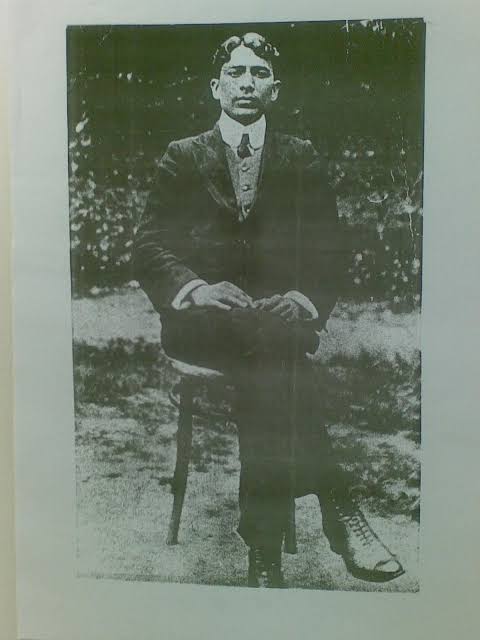
Reproduced from a printed book page, which accounts for the coarse grain and the fold marks. The image is shown complete and uncropped.
04 · One image, seen whole
A young man on a garden chair
Nearly every portrait of Dhingra in circulation — the stamp, the paintings, the illustrations, the framed images carried through Amritsar each August — is a crop of the head and shoulders from this photograph. Seen whole, it is a different kind of document.
It shows an ordinary studio-style portrait of an Edwardian student: a three-piece suit, a high collar, laced boots, a bentwood chair set on grass. It is the sort of photograph young men sent home. There is nothing in it to distinguish him from the hundreds of other Indian students in Britain, which is precisely why it is worth looking at.
The place and date are not recorded in the sources consulted here, and this archive does not assign them. What can be said is that it is the only photographic record of him that survives in general circulation, and that the familiar cropped face has been extracted from it.